

West Slopes Central
Backcountry Avalanche Forecast
Author: Lee Lazzara
Issued: Saturday, March 21, 2026 at 6:30 PM PDT
Expires: Sunday, March 22, 2026 at 6:30 PM PDT
The Bottom Line
 The Bottom Line
The avalanche danger is generally low, with pockets of danger below cliffs and other features still holding wet, unfrozen snow, especially where the sun adds additional warming. Avoid—or at least limit—travel directly below corniced ridgelines, glide cracks, and cliffs still holding snow.
Avalanche Danger
Sunday, March 22, 2026
7500-5500ft2 - Moderate

5500-4500ft2 - Moderate
4500-2500ft2 - Moderate
Monday, March 23, 2026
7500-5500ft1 - Low

5500-4500ft1 - Low
4500-2500ft1 - Low
Avalanche Danger ScaleLearn moreGeneral InfoGeneral Information1 - LowLow2 - ModModerate3 - ConsConsiderable4 - HighHigh5 - ExtrExtreme
1 - Low | 2 - Moderate |  3 - Considerable |  4 - High |  5 - Extreme | |
|---|---|---|---|---|---|
| Travel Advice | Generally safe avalanche conditions. Watch for unstable snow on isolated terrain features. | Heightened avalanche conditions on specific terrain features. Evaluate snow and terrain carefully; identify features of concern. | Dangerous avalanche conditions. Careful snowpack evaluation, cautious route-finding and conservative decision-making essential. | Very dangerous avalanche conditions. Travel in avalanche terrain not recommended. | Extraordinarily dangerous avalanche conditions. Avoid all avalanche terrain. |
| Likelihood of Avalanches | Natural and human-triggered avalanches unlikely. | Natural avalanches unlikely; human-triggered avalanches possible. | Natural avalanches possible; human-triggered avalanches likely. | Natural avalanches likely; human-triggered avalanches very likely. | Natural and human-triggered avalanches certain. |
| Avalanche Size and Distribution | Small avalanches in isolated areas or extreme terrain. | Small avalanches in specific areas; or large avalanches in isolated areas. | Small avalanches in many areas; or large avalanches in specific areas; or very large avalanches in isolated areas. | Large avalanches in many areas; or very large avalanches in specific areas. | Very large avalanches in many areas. |
Avalanche Problems (1)
Problem #1: Glide Avalanches
Problem Type
Glide Avalanches
Aspect/Elevation
Likelihood
Size
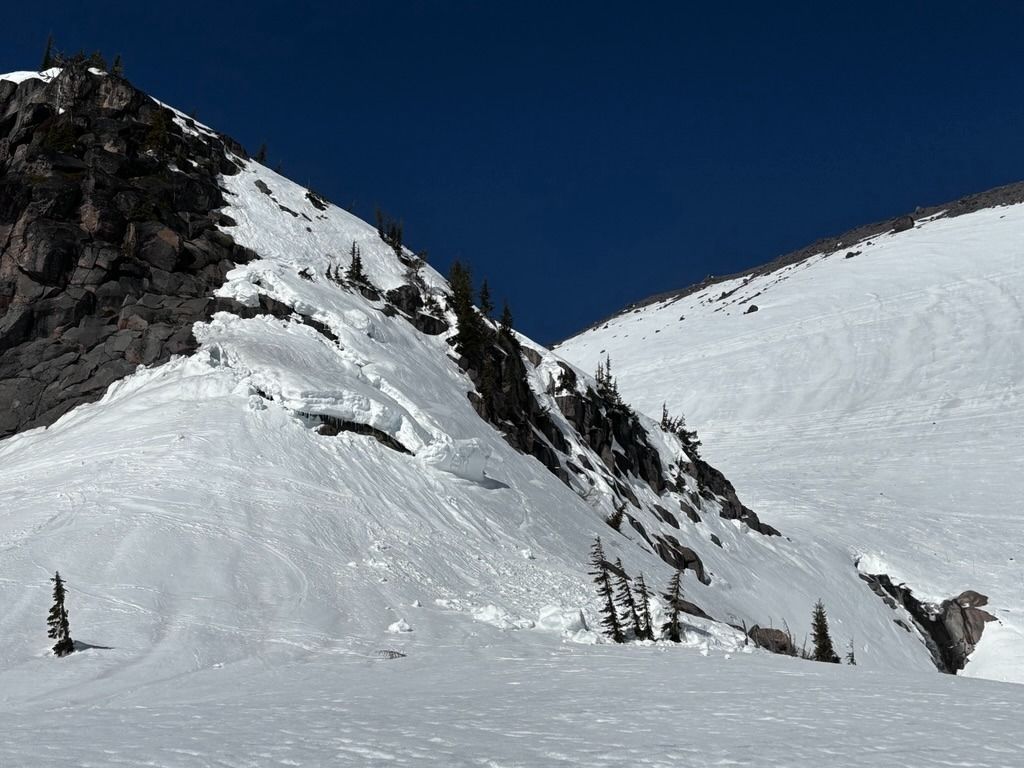
(3/7/2025)
Areas seeing sunny weather could also see features like this one continue to sporadically shed snow. Fortunately, they are also very easy to identify and avoid.
Photo: Joe Dellaporta
Glide avalanches, cornice fall, and other wet avalanche problems are keeping the danger from dropping for another day. Likelihood is low, and distribution is isolated, but consequences remain high—even a small chunk of dense, wet snow could cause serious harm, and a larger release or cornice fall would be far more dangerous. The surface will become firmer with cooling, but unconsolidated wet snow likely still lurks just below.
The greatest risk exists beneath steep, snow-covered cliffs receiving enough sun to keep melting active. These aren’t avalanches you can reliably assess, and you’re unlikely to trigger them. The only real strategy is to limit exposure.
Forecast Discussion
If you travel into high alpine terrain, you may find small, stiff wind slabs on leeward slopes. These are unlikely to pose much danger unless you’re in steep, consequential terrain with cliffs, crevasses, or other hazards below. Assess how well these slabs are bonded before stepping into steep terrain.
Any hazard out there is probably more in line with objective mountain hazards than how we might normally think of avalanche danger. For most people in most of the terrain that sees the most backcountry traffic, it’s effectively Low. The terrain where you might actually see a glide or similar avalanche would be on cliffs, rocky features, or weird, low-elevation areas where wet snow is still clinging to very steep slopes.
Folks who were out and about in the Cascades found that wet snow surfaces were firming up and becoming crusty. The only dry new snow was found way up high on the Coleman Glacier of Mt. Baker, starting at 7000 feet. Moderate winds had drifted some of this snow into small slabs. Signs of previous avalanche activity were found throughout the Cacades, but no new avalanches were reported as of late Saturday afternoon.
This information is provided by the U.S.D.A. Forest Service and describes general backcountry avalanche hazard and conditions.
It does not apply to ski areas and highways where avalanche mitigation is conducted.